
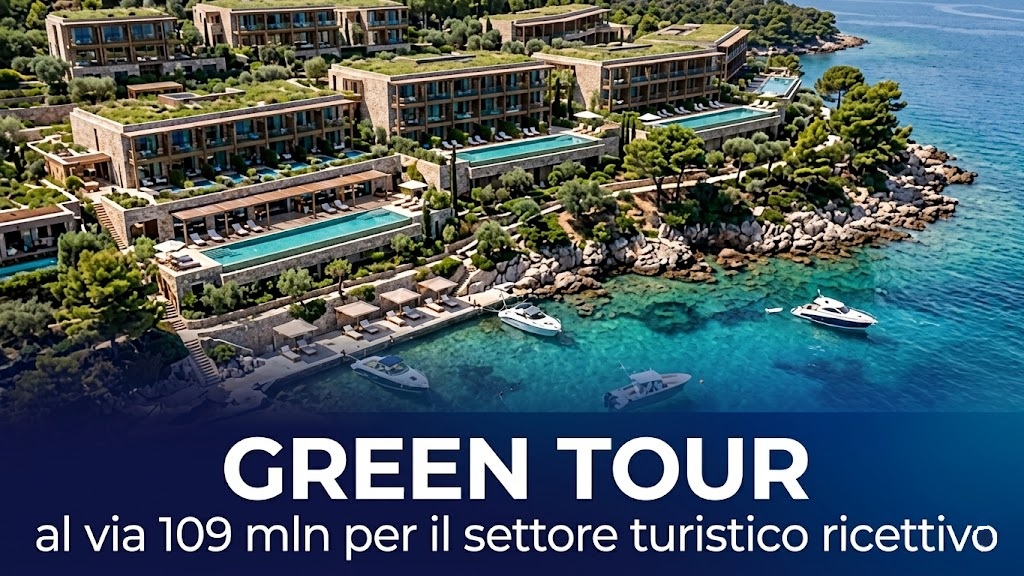
MITUR – €109 million to develop a more digital and sustainable national tourism offering. Applications from 15 July to 15 September
The Ministry of Tourism measure allocates €109 million and introduces a merit-based ranking that rewards engineering soundness, energy sustainability and economic-financial reliability. Application window from 15 July to 15 September 2026.
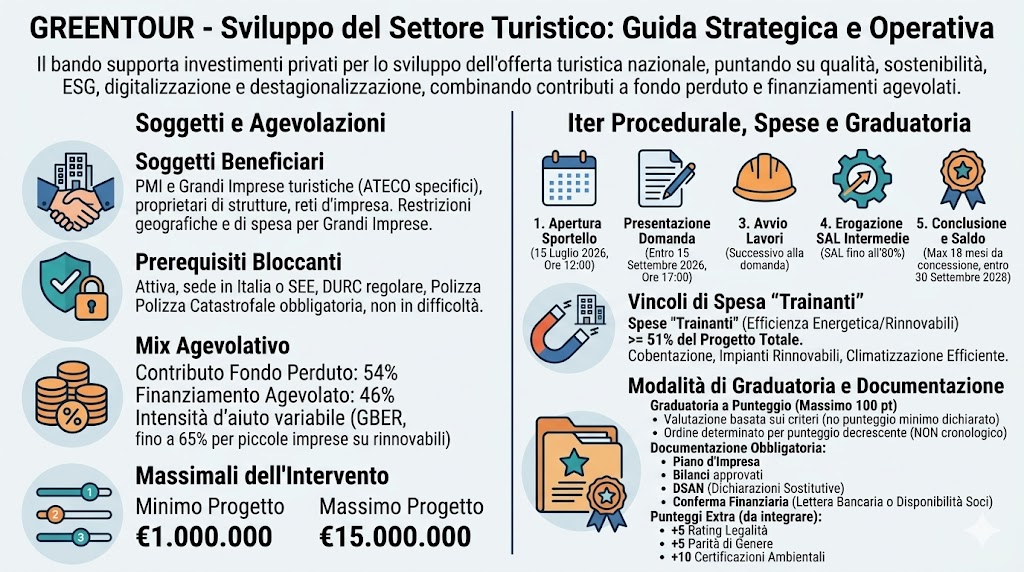
The Directorial Decree of the Ministry of Tourism has been published, defining how the measure introduced by the 2025 Budget Law to support the development of the national tourism offering will operate. The measure, which allocates a total of €109 million, marks the introduction of a merit-based ranking assessment procedure that abandons the pure "Click Day" logic in order to reward projects with greater engineering soundness, energy sustainability and economic-financial reliability.
While the intensity of the aid mix offers hospitality companies a significant lever for upgrading their assets, the procedural architecture, the constraints of the GBER Regulation and the access requirements impose a strict compliance protocol whose management calls for integrated specialist expertise.
The main pillars of the measure and the related technical obligations are analysed below.
1. Structure of the incentive and the "Predefined Mix" mechanism
The incentive departs from general estimates to apply a rigid, predefined financial split, calculated on the maximum aid intensity applicable to the project and designed to keep the ministerial budget in balance:
- 54% of the incentive granted as a non-repayable grant.
- 46% of the incentive granted as a subsidised loan.
In terms of ceilings, the call sets the minimum threshold for eligible projects at €1,000,000.00 and the maximum limit at €15,000,000.00. The subsidised loan carries an interest rate equal to 20% of the European reference rate in force at the date of award, to be repaid in constant deferred half-yearly instalments (fixed due dates on 30 June and 31 December). A technical pre-amortisation period is introduced, during which the company is required to pay only the accrued financial interest.
2. Objective scope: the 51% "leading interventions" requirement
Project eligibility is subject to a precise constraint on the composition of expenditure. Interventions aimed at improving energy efficiency and/or producing energy from renewable sources, defined as "leading interventions", must account for at least 51% of the programme's total eligible expenditure (a constraint applied to the individual company even in the case of network contracts).
The investment structure is broken down as follows:
- Leading Interventions (Art. 38 and 38-bis GBER): Insulation, window and door replacement, ventilated façades, green roofs, high-efficiency condensing boilers, intelligent centralised climate control and structural restoration of pre-existing buildings that have been demolished or have collapsed. Also included are renewable energy generation systems (photovoltaic, solar thermal, geothermal and heat pumps) and the related storage systems (behind-the-meter), provided the latter absorb at least 75% of the energy generated on an annual basis. Such systems are eligible only within the limits of the facility's self-consumption.
- Additional, Digitalisation and Accessory Interventions (driven): Rainwater retention and reuse systems, charging stations for electric vehicles, infrastructure for building automation and the integration of Artificial Intelligence, internal passive cabling, software and licences. Under the De Minimis regime, lightweight structures such as climate pergolas and the replacement of flooring with sustainable materials are admitted as accessories.
3. Timing profile and the logistics of variations: the start date
A crucial aspect concerns the timing management of the project and the eligibility of expenditure, governed by mandatory deadlines:
- Incurrence (spending window): Only expenditure incurred and initiatives started after submission of the incentive application are eligible. The start is identified with the beginning of construction works or with the first legally binding commitment ordered (e.g. an advance on equipment). Preparatory work, such as feasibility studies and applications for administrative permits, does not constitute the start of works and may precede it.
- Implementation schedule: Projects must be completed within 18 months of the award and, in any case, by 30 September 2028 at the latest. Evidence of building titles and planning permits must be produced within 120 days of the award (extendable only once by a further 120 days, exclusively for reasons of force majeure).
- Management of variations: Any change relating to the legal nature of the beneficiary or to the investment plan must be communicated to the Ministry in advance and submitted to technical review; a negative outcome entails the immediate total or partial revocation of the funds.
4. The access path: the Ranking
Unlike previous tourism-sector calls, the new regulatory framework introduces a window-based assessment procedure built on a ranking. The online portal will remain open from 12:00 on 15 July 2026 until 17:00 on 15 September 2026.
All applications submitted within this time window will be treated as having arrived at the same instant. The position in the ranking, essential for access to Invitalia's review phase, will be determined by a merit score (maximum 100 points) calculated on the basis of:
- Technical indicators of the weight of green and digital investments.
- Objective indicators of economic-financial soundness drawn from the latest filed financial statements (Gross Operating Margin, financial independence, debt ratio, weight of financial charges).
- Score increases for holding a Legality Rating (+5 points), a Gender Equality Certification (+5 points) and recognised environmental certifications such as GSTC, Green Key, ISO 14001/50001 or EMAS (+10 points).
In the event of a tie, the call establishes that the application with the lowest overall cost will prevail.
5. Cumulation rules and GBER intensity in Assisted Areas
The maximum aid intensity provided for energy-efficiency expenditure (equal to a 30% base) can be increased by combining the various uplifts allowed under the GBER Regulation:
- +20 percentage points for small enterprises; +10 percentage points for medium-sized enterprises.
- +15 percentage points for investments carried out in zone "a" areas of the Regional Aid Map; +5 percentage points for zone "c" areas.
- +15 percentage points (Green Extra premium) where the interventions achieve a primary-energy saving of at least 40% compared with the pre-existing situation.
The combination of the two incentives (grant and loan) may not exceed 100% of the eligible costs. There is an obligation to keep separate accounts where the company carries out mixed activities or activities excluded from the GBER Regulation, ensuring that costs and benefits are attributable exclusively to the eligible tourism activities. Furthermore, for interventions falling under Articles 38 and 38-bis of GBER, there is an absolute prohibition on the eligibility of expenditure relating to fossil-fuel-powered systems.
Our organisation stands alongside tourism businesses to govern the entire compliance cycle: from the pre-intervention technical analysis for measuring primary energy, to the negotiation of banking coverage formats, through to the methodological structuring of the business plan and the monitoring of reporting deadlines, guaranteeing the full robustness of the application and the highest achievable score in the ranking.