
AI Act, Omnibus and Law 132/2025: the updated map
What the AI Act really requires after Regulation (EU) 2026/1744 and the implementing decrees of Italian Law 132/2025 – updated November 2026.
The starting point remains Regulation (EU) 2024/1689, the so-called AI Act, in force since 1 August 2024 and applicable in successive phases. This framework has been amended by Regulation (EU) 2026/1744 (the Digital Omnibus on AI), published in the Official Journal of the European Union on 24 July 2026 and in force since 27 July 2026, which changed some of the AI Act's deadlines and obligations. The parallel simplification package on the GDPR, cookies and other data rules follows a separate path and is still under discussion. In Italy, Law no. 132 of 23 September 2025, in force since 10 October 2025, has been implemented through two legislative decrees: Legislative Decree 160/2026 and Legislative Decree no. 179 of 7 October 2026, in force since 23 October 2026.
Rather than on the chronology of the legislative process, it is worth focusing on what these rules concretely require of companies. This is where the most demanding – and least known – part of compliance lies, and where clarity is needed against alarmist messages that often confuse obligations, deadlines and maximum penalties.
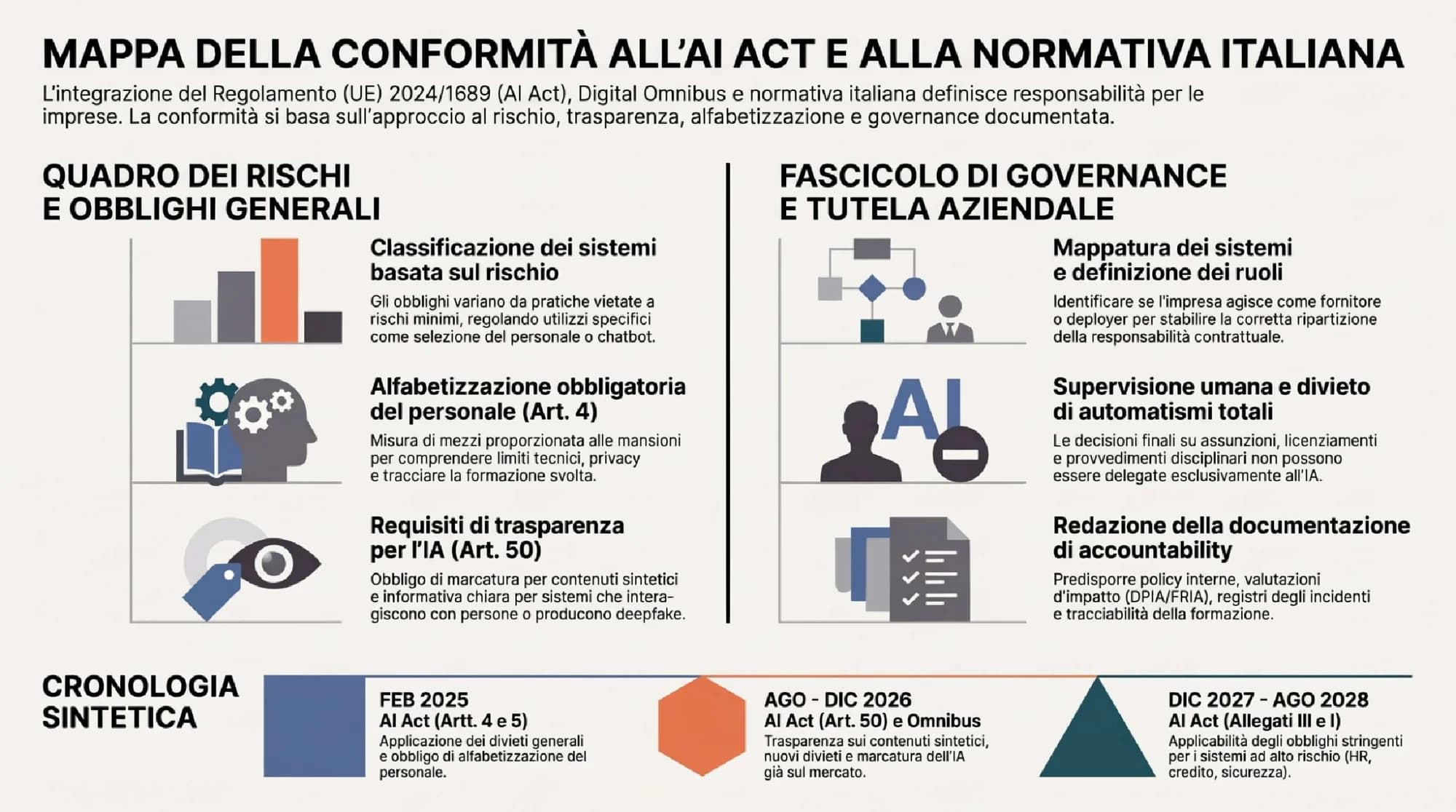
1. The logic of the AI Act: a risk-based approach
The AI Act does not regulate artificial intelligence in the abstract, but AI systems according to their intended use, on increasing levels of risk. Understanding which category a system falls into, and which role the company plays (provider or user, the deployer), is the first step of any compliance path: the applicable obligations depend on it. A customer service chatbot does not entail the same requirements as recruitment software.
- Unacceptable risk: practices prohibited by Art. 5, including manipulative or subliminal techniques causing significant harm, social scoring, emotion recognition in the workplace and in educational institutions (except for medical or safety reasons) and "real-time" remote biometric identification in publicly accessible spaces for law enforcement purposes, subject to narrowly defined exceptions;
- High risk: the systems listed in Annex III – for companies, above all those used for recruitment and decisions on the employment relationship, creditworthiness assessment of natural persons, pricing in life and health insurance, access to essential services – and systems that are safety components of products already regulated by EU legislation (Annex I);
- Transparency obligations: systems subject to the information obligations of Art. 50 (chatbots, generated or manipulated content, deepfakes), often referred to as "limited risk";
- Minimal risk: most everyday uses (spam filters, product recommendations), with no specific AI Act obligations. The GDPR and other general rules still apply, as does the cross-cutting obligation of AI literacy for staff (Art. 4), which concerns all providers and deployers of AI systems regardless of the level of risk.
Separately, the AI Act regulates general-purpose AI models (GPAI), such as large language models: the related obligations fall on those who develop the models, not on the companies that use them.
2. High-risk systems: in brief
They concern a minority of companies, but it is useful to know how they are structured. The most demanding obligations fall on the provider of the system: a risk management system covering the entire life cycle, data governance practices including the examination of possible biases and measures to detect, prevent and mitigate them, technical documentation, automatic recording of events (logging), a design that allows effective human oversight, appropriate levels of accuracy, robustness and cybersecurity, as well as conformity assessment and CE marking.
The deployer, i.e. the company using the system, has its own obligations (Art. 26): use it in accordance with the provider's instructions, assign oversight to competent people, monitor its operation, keep the logs it generates for at least six months and, if it is used in the workplace, inform the workers concerned and their representatives in advance. Bodies governed by public law, private entities providing public services and those using systems for creditworthiness or for life and health insurance must also carry out a fundamental rights impact assessment (FRIA, Art. 27). These obligations will apply from 2 December 2027 (see § 4).
For most companies, however, the truly relevant aspects – because they apply regardless of sector and affect the everyday use of generative AI – are others: transparency obligations and staff AI literacy.
3. Transparency, training and penalties: who has to do what
The transparency obligations of Art. 50 apply from 2 August 2026 and have not been postponed by the Omnibus, except for a short extension for the technical marking of content. Each obligation has a specific addressee – provider or deployer – and it is precisely this distinction that determines who has to do what:
- Systems interacting with people (chatbots, voice assistants, automated customer care) – provider's obligation: the system must be designed so that the person knows they are interacting with an AI, unless this is obvious to a reasonably well-informed, observant and circumspect person, taking into account the context. This concerns e-commerce sites, customer services, automated booking, virtual assistants on apps and social media;
- Synthetic content (audio, images, video, text) – provider's obligation: outputs must be marked in a machine-readable format and be detectable as artificially generated or manipulated; the obligation does not apply, for example, to simple editing-assistance functions. For systems already placed on the market before 2 August 2026, the Omnibus grants time until 2 December 2026. Those who use these tools must check that the provider is compliant;
- Emotion recognition and biometric categorisation – deployer's obligation: those using these systems must inform the people exposed to them and process data in compliance with the GDPR;
- Deepfakes – deployer's obligation: those using AI to generate or manipulate images, audio or video resembling real people, places or events that could falsely appear authentic must disclose that the content is artificial. If the content is part of an evidently artistic, creative, satirical or fictional work, it is enough to disclose its existence in a way that does not hamper the enjoyment of the work. This concerns, for example, advertising videos with digitally recreated testimonials or social media content with synthesised faces or voices;
- Texts published to inform the public on matters of public interest – deployer's obligation: they must be disclosed as AI-generated or manipulated, unless they have undergone human review or editorial control and a natural or legal person holds editorial responsibility for them. This may concern press releases and informational content published by the company; ordinary promotional content does not automatically fall into this category.
An operational point that is often overlooked is the qualification of the role. Most companies do not develop their own models and act as deployers of third-party tools. Be careful, though: anyone who develops – or has developed – a system, for example a chatbot based on a third-party model, and puts it into service under their own name or trademark may qualify as the provider of that system, with the related obligations. In any case, the company must check, including contractually, that the transparency obligations incumbent on the provider are met, and directly oversee those that fall on it as deployer.
Two topics surrounded by a great deal of commercial misinformation are linked to this: training and penalties.
AI literacy (Art. 4). Since 2 February 2025, providers and deployers of AI systems must take care of the skills of those who use them. The Omnibus has reworded the rule: the obligation now consists of taking measures to foster AI literacy among staff and other people using the systems on the company's behalf, taking into account their technical knowledge, experience, education and the context of use, so that they understand the technical limits (e.g. the risk of "hallucinations" or discriminatory bias), the protection of business and personal data (GDPR) and the proper exercise of human oversight over outputs. The rule expressly clarifies that ensuring a specific level of individual competence is not required: it is an obligation of means, not of result. No accredited bodies, paid certifications or minimum number of hours are needed: training can also be delivered internally, as long as it is proportionate to the tasks performed and documented (through programmes, internal guidelines, attendance registers or certificates). Specific rules apply instead to professionals registered with professional bodies, for whom Legislative Decree 179/2026 provides AI courses in initial and continuing education.
Penalties (Art. 99). The maximum of 35 million euro or 7% of total worldwide annual turnover applies only to the practices prohibited by Art. 5. For breaches of the other obligations of operators, including the transparency obligations of Art. 50, the cap is 15 million or 3%; for incorrect, incomplete or misleading information supplied to authorities, 7.5 million or 1%. For companies in general, the higher of the fixed amount and the percentage applies; for SMEs, start-ups and – after the Omnibus – small mid-caps, the lower amount applies. These are maximum amounts: the actual penalty is proportionate to the seriousness, duration, size of the company and other criteria. In Italy, Legislative Decree 179/2026 has adopted these maximums, introduced a lower national band (up to 1 million euro or 0.5% of turnover) for the fundamental rights impact assessment and the right to explanation, and non-pecuniary measures for minor violations. Art. 4 is not among the obligations referred to in Art. 99 (so there is no automatic penalty for lacking a training "seal"), but the absence of documented training measures is an aggravating factor of organisational fault that weighs in inspections and in the assessment of any liability for damages, privacy breaches or employment disputes.
4. What the Digital Omnibus on AI has changed
Regulation (EU) 2026/1744 does not change the risk-based framework, but acts on timing and on some obligations. The main changes for companies are:
- High-risk systems in Annex III (employment, credit, essential services): obligations applicable from 2 December 2027 instead of 2 August 2026;
- AI embedded in products already regulated (Annex I, e.g. medical devices, toys, lifts): from 2 August 2028 instead of 2 August 2027; AI in machinery has been brought under the Machinery Regulation;
- AI literacy (Art. 4): reworded as an obligation to take measures, without guaranteeing an individual level of competence;
- New prohibitions from 2 December 2026: concerning the AI generation of intimate images of identifiable people without their consent and of child sexual abuse material;
- Marking of synthetic content: extended to 2 December 2026 for systems already on the market before 2 August 2026;
- Small mid-caps: companies that exceed the SME thresholds but remain within those of Recommendation (EU) 2025/1099 benefit from facilitations previously reserved for SMEs, including simplified documentation and the lower penalty cap.
The Regulation also introduces a legal basis for processing special categories of data in order to detect and correct bias, and strengthens the role of the European AI Office. The prohibitions already applicable since 2025, the rules on GPAI models and the transparency obligations of Art. 50, which apply from 2 August 2026, remain unchanged.
5. Italian Law 132/2025 and the implementing decrees
Law 132/2025 must be applied in accordance with the AI Act and states that it does not introduce obligations beyond those of the Regulation for AI systems and models. It sets out general principles (centrality of the person, transparency, non-discrimination, human oversight) and sector-specific provisions. For companies, the following are particularly relevant: Art. 11, under which employers must inform workers of the use of AI in the cases and in the manner set out in Art. 1-bis of Legislative Decree 152/1997; Art. 13, which for intellectual professions allows the use of AI only for instrumental and support activities, with intellectual work prevailing and the client being informed; and the new offence under Art. 612-quater of the Italian Criminal Code (unlawful dissemination of content generated or altered with AI systems).
The delegated powers have been exercised through two legislative decrees. Legislative Decree 160/2026 concerns the use of AI in police activities and civil and criminal liability. Legislative Decree 179/2026, in force since 23 October 2026, defines national governance: AgID is the notifying authority; ACN is the market surveillance authority and single point of contact; the Bank of Italy, CONSOB and IVASS supervise high-risk systems used in the services within their respective remit; the Italian Data Protection Authority (Garante privacy) is a market surveillance authority within the limits of Art. 74(8) of the AI Act, without prejudice to its general powers on data protection.
For employers, Legislative Decree 179/2026 establishes that final decisions on the establishment, modification and termination of the employment relationship – including disciplinary measures and performance assessments – cannot be taken solely on the basis of automated processing. The worker's consent does not allow derogation from this prohibition and decisions taken in breach of it are null and void; candidate search and selection activities are not considered final decisions. The European postponement for high-risk systems does not affect these national rules, which are already in force.
6. The policy and governance file
This framework creates, for any company using AI in its processes, a duty of accountability: building a documentary file of AI policy and governance capable of demonstrating the choices made in the event of an inspection. A solid file should contain at least:
- a map of the AI systems in use, with the company's role (provider or deployer) and the risk category;
- an internal policy on who can use AI, for which activities and within which limits;
- AI literacy measures (Art. 4 AI Act), proportionate to tasks and documented: programme, materials, register of participants;
- information notices: to workers (Art. 1-bis of Legislative Decree 152/1997 and Art. 11 of Law 132/2025) and, where relevant, to customers and users (Art. 50 AI Act);
- effective human oversight, in particular over decisions concerning people;
- impact assessments: the DPIA under Art. 35 GDPR when the processing presents high risks and, for the deployers required to do so, the FRIA under Art. 27 AI Act;
- contractual checks on providers of AI tools (roles, compliance with Art. 50, information provided);
- a register of incidents and of periodic reliability checks.
Key deadlines at a glance
- AI Act, Arts. 4 and 5 – prohibitions and AI literacy: prohibited AI practices; measures for staff AI literacy (Art. 4 as reworded by the Omnibus). Applicable since 2 February 2025.
- AI Act – GPAI models and penalties (Art. 99): obligations of providers of general-purpose AI models; penalty regime. Since 2 August 2025 (Commission enforcement powers on GPAI models from 2 August 2026).
- AI Act, Art. 50 – transparency: chatbots, marking of synthetic content, deepfakes, texts of public interest. Applicable from 2 August 2026; marking for systems already on the market by 2 December 2026.
- AI Act, Art. 5 – new prohibitions: AI generation of non-consensual intimate images of identifiable people and of child sexual abuse material. From 2 December 2026.
- AI Act – high risk (Annex III): recruitment and staff management, creditworthiness, life and health insurance, essential services, education, justice. From 2 December 2027 (originally 2 August 2026).
- AI Act – high risk (Annex I): AI as a safety component of products already regulated (e.g. medical devices, toys, lifts). From 2 August 2028 (originally 2 August 2027).
- Reg. (EU) 2026/1744 – Digital Omnibus on AI: amends the timetable and some obligations of the AI Act. Published in the OJEU on 24 July 2026; in force since 27 July 2026.
- Digital Omnibus (data): proposed amendments to the GDPR, cookie rules (e-Privacy), the Data Act and other digital rules. Still under discussion at first reading; no completion date.
- Law 132/2025: general principles and sector-specific provisions. Published on 25 September 2025; in force since 10 October 2025.
- Legislative Decrees 160/2026 and 179/2026: implementation of Law 132/2025 – AI in police activities and liability; authorities, penalties, training, employment. Legislative Decree 179/2026 in force since 23 October 2026.
Why it still does not pay to wait
The postponement only concerns the obligations on high-risk systems. The GDPR, Art. 4 on AI literacy, the prohibitions of Art. 5, the transparency obligations of Art. 50, Law 132/2025 and its implementing decrees already apply. Moreover, a recruitment or credit assessment system chosen today will most likely still be in use when the obligations become applicable: it is worth asking the provider now how it intends to comply.
For an SME, this means starting a proportionate path – without giving in to alarmism about maximum penalties or to standardised training packages – and working methodically: mapping where AI is already in use, understanding what data it processes, training those who use it in a targeted and traceable way, and putting in writing the rules the company sets itself for using it responsibly.